
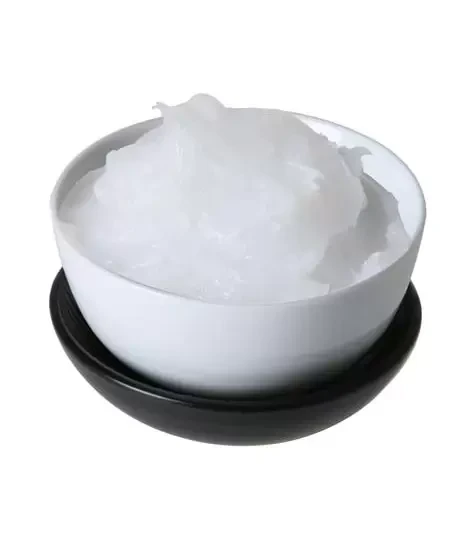
Cosmetic Grade Petroleum Jelly
Cosmetic Grade Petroleum Jelly is a semi-solid mixture of highly refined
hydrocarbons derived from petroleum. It is white or off-white in color, smooth
in texture, and virtually odorless and tasteless. Widely used in skincare and
personal care products, it acts as an occlusive agent that forms a protective
barrier on the skin to lock in moisture and aid in healing dry, cracked, or
irritated skin. It is used in lip balms, moisturizers, baby care products, hair
pomades, and other topical formulations. Cosmetic grade petroleum jelly
undergoes extensive purification to remove impurities, ensuring it is safe for
use on the skin and meets international cosmetic safety standards.
Specification for Cosmetic Grade Petroleum Jelly
- Appearance:
White or off-white, smooth, semi-solid mass; translucent when spread thin.
- Odor:
Odorless or very faint hydrocarbon odor.
- Melting
Point: Typically between 38°C and 60°C.
- Solubility:
Insoluble in water and alcohol; soluble in chloroform and ether.
- Acidity
or Alkalinity: Neutral (passes pH test, non-irritant to skin).
- Drop
Point: 42°C to 60°C (depending on grade).
- Polycyclic
Aromatic Hydrocarbons (PAHs): Must comply with cosmetic regulations
(free from carcinogenic PAHs).
- Color:
White to pale yellow (meets standards for visual clarity and consistency).
- Consistency:
Homogeneous, smooth, and free from gritty particles.
- UV
Absorbance: Meets purity standards (typically tested between 220–400
nm).
- Residue
on Evaporation: Minimal or none.
- Microbial
Limit Test: Should be free from pathogenic microorganisms (e.g., E.
coli, Staphylococcus aureus).
- Heavy
Metals (Pb, As, Hg): Within permitted cosmetic safety limits
(typically <10 ppm).